Claude on Models
TL;DR
Claude, from Anthropic, is an extremely powerful AI tool. I will use it here to help me think about the use of models. A link to the interaction.
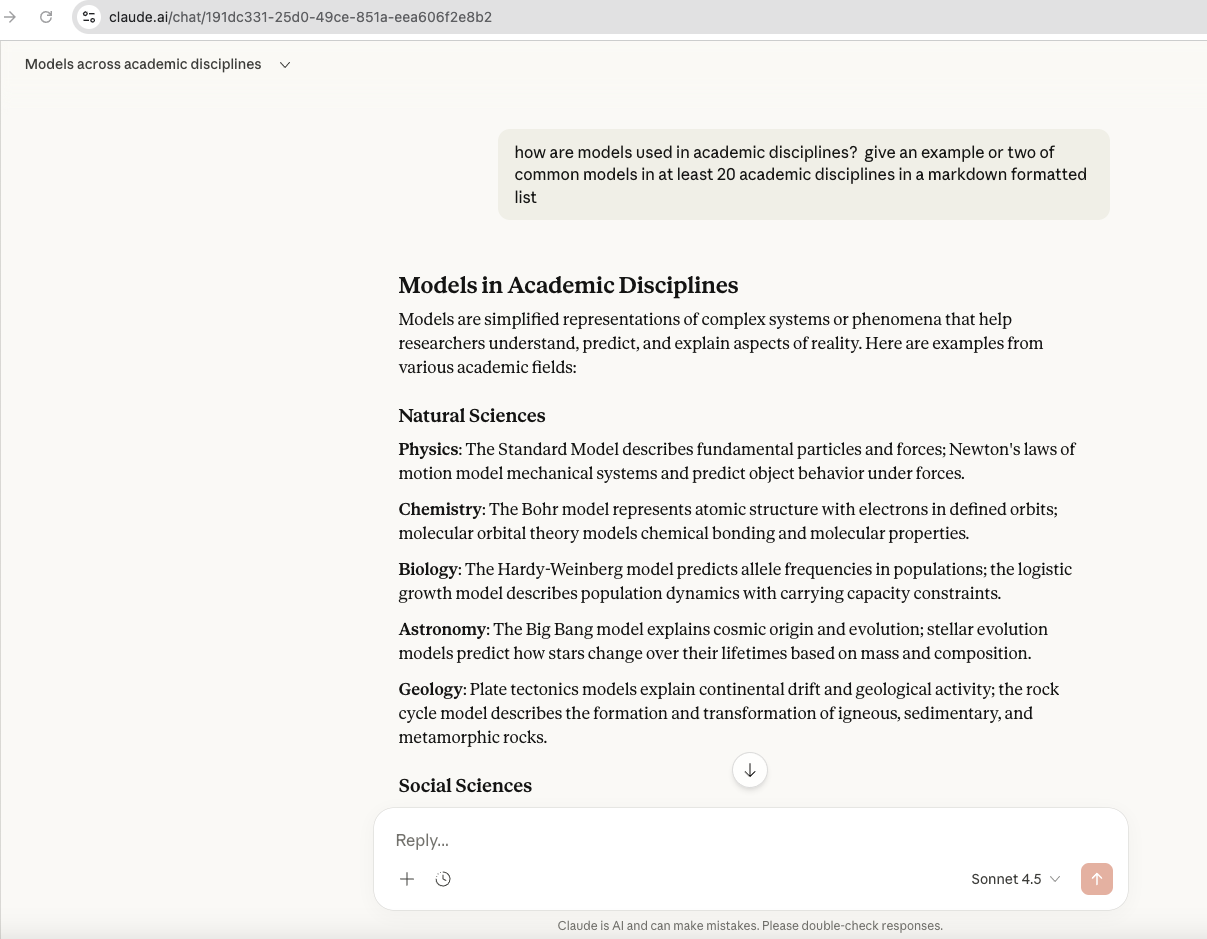
how are models used in academic disciplines? give an example or two of common models in at least 20 academic disciplines in a markdown formatted list
could you provide this response as a bulleted list in markdown code with a linked reference for each such model that provides more detail?
Models in Academic Disciplines
Natural Sciences
Physics: The Standard Model describes fundamental particles and forces; Newton’s laws of motion model mechanical systems and predict object behavior under forces. Standard Model | Newton’s Laws
Chemistry: The Bohr model represents atomic structure with electrons in defined orbits; molecular orbital theory models chemical bonding and molecular properties. Bohr Model | Molecular Orbital Theory
Biology: The Hardy-Weinberg model predicts allele frequencies in populations; the logistic growth model describes population dynamics with carrying capacity constraints. Hardy-Weinberg | Logistic Growth
Astronomy: The Big Bang model explains cosmic origin and evolution; stellar evolution models predict how stars change over their lifetimes based on mass and composition. Big Bang | Stellar Evolution
Geology: Plate tectonics models explain continental drift and geological activity; the rock cycle model describes the formation and transformation of igneous, sedimentary, and metamorphic rocks. Plate Tectonics | Rock Cycle
Applied Sciences
Medicine: The biopsychosocial model integrates biological, psychological, and social factors in health; epidemiological models (like SIR) predict disease spread through populations. Biopsychosocial Model | SIR Model
Engineering: Finite element models simulate stress and strain in structures; circuit models represent electrical systems using idealized components like resistors and capacitors. Finite Element Method | Circuit Theory
Computer Science: The OSI model describes network communication in seven layers; computational complexity models classify algorithms by their time and space requirements. OSI Model | Computational Complexity
Environmental Science: Climate models simulate Earth’s atmospheric and oceanic systems; ecosystem models track energy flow and nutrient cycling through trophic levels. Climate Models | Ecosystem Model
Humanities and Formal Sciences
Linguistics: Chomsky’s transformational-generative grammar models sentence structure and syntax; phonological models represent sound systems and pronunciation rules. Transformational Grammar | Phonology
Mathematics: Euclidean geometry models flat space using axioms and theorems; probability models describe random events and their likelihood. Euclidean Geometry | Probability Theory
Philosophy: The theory of forms models reality as imperfect reflections of perfect ideals; utilitarian models evaluate moral actions based on consequences and overall happiness. Theory of Forms | Utilitarianism
History: Cyclical models view history as repeating patterns; the Annales school model examines long-term social and economic structures rather than just political events. Cyclical Theory | Annales School
Education: Bloom’s taxonomy models learning objectives in hierarchical cognitive levels; constructivist models view learning as active knowledge construction by students. Bloom’s Taxonomy | Constructivism
Geography: The von Thünen model predicts agricultural land use patterns around markets; gravity models estimate interaction between places based on size and distance. Von Thünen Model | Gravity Model
Social Sciences
Economics: Supply and demand models predict market equilibrium prices; the Solow growth model explains long-term economic growth through capital accumulation and technological progress. Supply and Demand | Solow Model
Psychology: The cognitive-behavioral model links thoughts, emotions, and behaviors; Piaget’s stages of development model children’s cognitive growth through distinct phases. Cognitive-Behavioral | Piaget’s Theory
Sociology: The structural-functional model views society as interconnected parts working toward stability; social network models map relationships and information flow between individuals. Structural Functionalism | Social Network Analysis
Political Science: The median voter theorem models electoral outcomes in democratic systems; game theory models strategic interactions between political actors. Median Voter Theorem | Game Theory
Anthropology: Cultural evolution models explain how cultural traits spread and change; kinship models represent family relationships and social organization across cultures. Cultural Evolution | Kinship