Gemini on Business Models
TL;DR
Gemini is powerful, and a few tidbits help a great deal; NotebookLM makes it even more powerful.
Detailed Post
provide a detailed discussion of the use of models in business disciplines and provide at least two examples of common models in use in each common business discipline, double check your work and provide references for each that could be followed. format the response as markdown code
The Role and Application of Models in Business Disciplines
In business, a model is a theoretical construct or framework that represents real-world processes, systems, or relationships. Models simplify complex realities to help managers, analysts, and stakeholders understand, predict, and control business environments.
The Utility of Business Models
Models serve three primary functions across all disciplines: 1. Simplification: They strip away noise to focus on key variables (e.g., price vs. demand).
2. Communication: They provide a shared language and visual structure for teams (e.g., a supply chain diagram).
3. Prediction and Decision Support: They allow for scenario planning and “what-if” analyses (e.g., financial forecasting).
1. Strategic Management
Strategy models assist leaders in analyzing competitive environments and internal capabilities to define long-term goals.
Example A: Porter’s Five Forces
Overview: Developed by Michael Porter, this model analyzes the competitive intensity and attractiveness of an industry.
Components: 1. Threat of New Entrants: Barriers to entry (capital, regulation).
2. Bargaining Power of Suppliers: Concentration of suppliers, switching costs.
3. Bargaining Power of Buyers: Price sensitivity, volume of purchase.
4. Threat of Substitute Products: Alternative solutions meeting the same need.
5. Rivalry Among Existing Competitors: Number of competitors, industry growth.
Application: Used to determine whether to enter a new market or how to position a firm to defend against competitive forces.
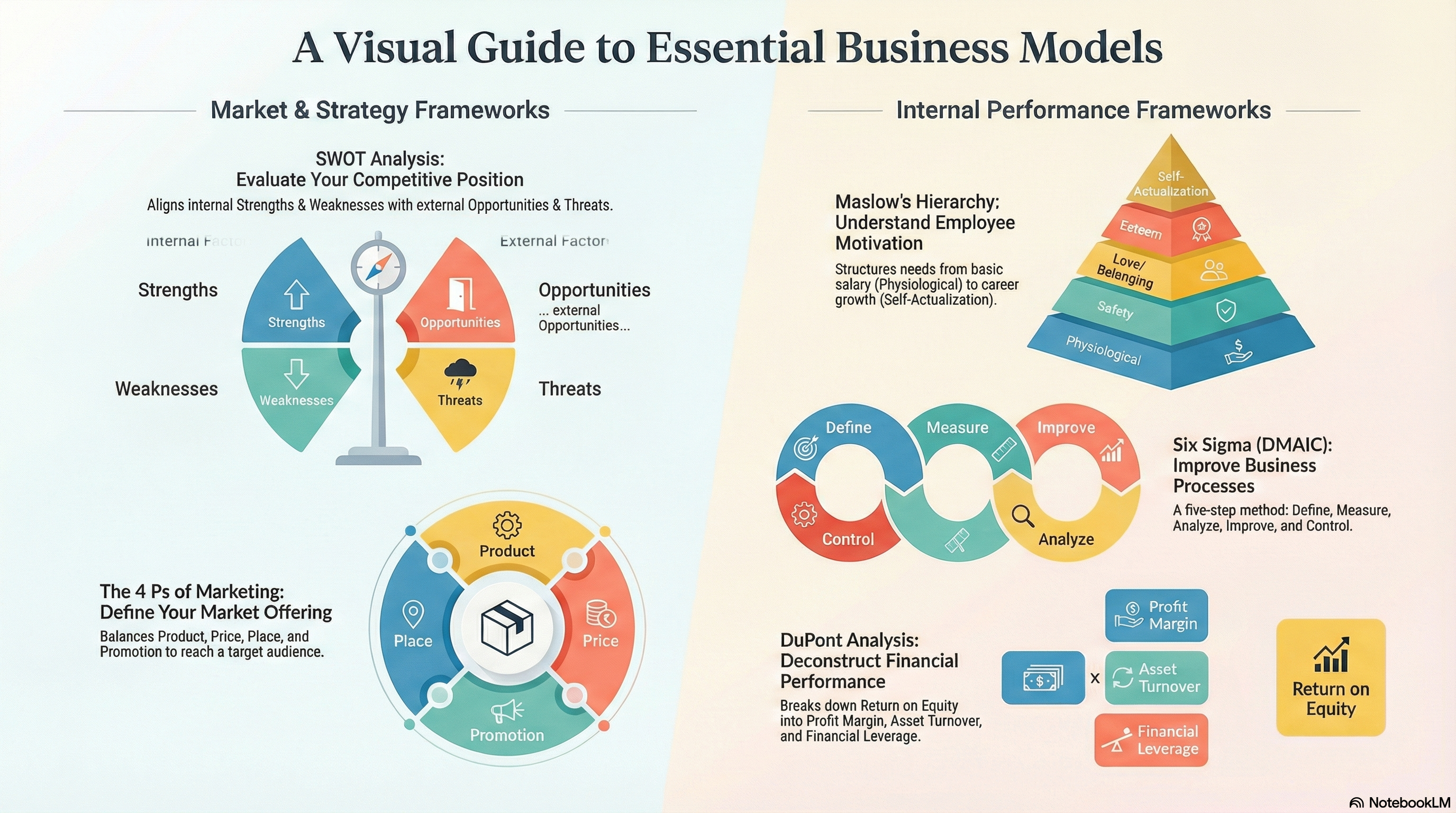
Example B: SWOT Analysis
Overview: A foundational framework used to evaluate a company’s competitive position. Components:.
* Strengths (Internal): Unique assets, strong brand, proprietary tech.
* Weaknesses (Internal): Resource gaps, poor reputation, lack of capital.
* Opportunities (External): Emerging markets, changing regulations, tech advancements.
* Threats (External): New competitors, economic downturns, changing consumer behavior.
Application: Used during strategic planning retreats to align internal capabilities with external possibilities.
References: * Porter, M. E. (1979). “How Competitive Forces Shape Strategy”. Harvard Business Review. * Humphrey, A. (2005). “SWOT Analysis for Management Consulting”. SRI International.
2. Marketing
Marketing models help firms understand customer behavior, segment populations, and optimize the value proposition.
Example A: The Marketing Mix (The 4 Ps)
Overview: A model to outline the key factors that determine a product’s offer.
Components:.
1. Product: Features, quality, branding, packaging.
2. Price: List price, discounts, payment terms.
3. Place: Distribution channels, logistics, market coverage.
4. Promotion: Advertising, sales force, public relations.
Application: Used to draft go-to-market strategies and ensure all aspects of the offering are aligned with the target audience.
Example B: STP Model (Segmentation, Targeting, Positioning)
Overview: A strategic approach that prioritizes the customer over the product.
Components:.
1. Segmentation: Dividing the market into distinct groups (demographic, psychographic).
2. Targeting: Selecting the most attractive segments to focus on.
3. Positioning: Creating a distinct image in the mind of the target audience compared to competitors.
Application: Essential for digital marketing campaigns to ensure ad spend is directed toward high-conversion audiences.
References: * McCarthy, E. J. (1960). Basic Marketing: A Managerial Approach. Irwin. * Kotler, P., & Keller, K. L. (2015). Marketing Management. Pearson.
3. Finance and Accounting
Financial models are often mathematical, used to value assets, assess risk, and analyze performance.
Example A: CAPM (Capital Asset Pricing Model)
Overview: Describes the relationship between systematic risk and expected return for assets, particularly stocks.
Formula: \[E(R_i) = R_f + \beta_i (E(R_m) - R_f)\]
- \(E(R_i)\): Expected return of investment.
- \(R_f\): Risk-free rate.
- \(\beta_i\): Beta (sensitivity of the asset to market movements).
- \((E(R_m) - R_f)\): Market risk premium.
Application: Used in corporate finance to determine the cost of equity capital and to evaluate the performance of managed portfolios.
Example B: DuPont Analysis
Overview: A technique to decompose Return on Equity (ROE) to understand the drivers of financial performance.
Formula: \[ROE = \text{Profit Margin} \times \text{Asset Turnover} \times \text{Financial Leverage}\]
- Profit Margin: Operational efficiency.
- Asset Turnover: Asset use efficiency.
- Financial Leverage: Use of debt.
Application: Used by financial analysts to pinpoint whether a company’s growth is driven by high margins, efficient asset use, or high debt loading.
References: * Sharpe, W. F. (1964). “Capital Asset Prices: A Theory of Market Equilibrium under Conditions of Risk”. Journal of Finance. * Soliman, M. T. (2008). “The Use of DuPont Analysis by Market Participants”. The Accounting Review.
4. Operations and Supply Chain
Operations models focus on efficiency, quality control, and logistics optimization.
Example A: EOQ (Economic Order Quantity)
Overview: A formula that calculates the ideal order quantity a company should purchase to minimize inventory costs.
Formula: \[EOQ = \sqrt{\frac{2DS}{H}}\]
- \(D\): Demand in units.
- \(S\): Order cost (per order).
- \(H\): Holding costs (per unit, per year).
Application: Used in inventory management to balance the cost of ordering stock against the cost of holding it.
Example B: Six Sigma DMAIC
Overview: A data-driven quality strategy for improving processes.
Phases:.
1. Define: The problem and project goals.
2. Measure: Current process performance.
3. Analyze: The root causes of defects.
4. Improve: The process by eliminating causes.
5. Control: Future process performance to ensure deviations don’t recur.
Application: Used in manufacturing and service industries to reduce defects and improve consistency.
References: * Harris, F. W. (1913). “How Many Parts to Make at Once”. Factory, The Magazine of Management. * Pyzdek, T., & Keller, P. A. (2014). The Six Sigma Handbook. McGraw-Hill Education.
5. Human Resources (Organizational Behavior)
HR models attempt to quantify or structure the “soft skills” of motivation, leadership, and organizational structure.
Example A: Maslow’s Hierarchy of Needs (Applied to Business)
Overview: A psychological theory arguing that humans have tiers of needs that must be met in order.
Tiers:.
1. Physiological: Salary, basic working conditions.
2. Safety: Job security, health insurance.
3. Social: Team culture, belonging.
4. Esteem: Job titles, recognition, awards.
5. Self-Actualization: Career growth, autonomy, creative work.
Application: Used to design compensation packages and employee engagement programs.
Example B: The HR Business Partner Model (Ulrich Model)
Overview: Defines how HR should be organized to deliver value.
Four Roles:.
1. Strategic Partner: Aligning HR with business strategy.
2. Change Agent: Managing transformation and culture.
3. Administrative Expert: Efficiently managing processes (payroll, benefits).
4. Employee Champion: Listening to and advocating for employees.
Application: Used to restructure HR departments to move away from purely administrative tasks toward strategic contribution.
References: * Maslow, A. H. (1943). “A Theory of Human Motivation”. Psychological Review. * Ulrich, D. (1996). Human Resource Champions. Harvard Business School Press.
It produces a variety of content.
and an