The probability of any event is greater than or equal to zero.
Why Jaynes?
His approach is intuitive. If you are familiar with probability already, some of you have formal training, Appendix A sets out the key differences.
Why did I ask you to read this? He builds a basic foundation. He derives rules. Those rules are the same rules that we will deploy. But he does it from more basic foundations. Yes, he can do math. That’s not the point; there is a simple representation of all of these ideas. And only a small number of rules that we will define precisely.
Where does Probability Come From?
There are three common sources of probabilities:
Known formula [Dice, Coins, etc.]
Empirical frequency
Subjective belief
Jaynes is a proponent of the latter.
A priori probability
The probability of a given integer on a k-sided die: \frac{1}{k}.
The probability of heads with a fair coin: \frac{1}{2}.
The probability of a Queen? \frac{4}{52}
The probability of a Diamond? \frac{13}{52}
The Queen of Diamonds? \frac{1}{52} or (\frac{4}{52}\times\frac{13}{52})
M.F No Yes
Female 0.2823685 0.1230667
Male 0.3298719 0.2646929
prop.table(table(UCBAdmit$M.F,UCBAdmit$Admit))
No Yes
Female 0.2823685 0.1230667
Male 0.3298719 0.2646929
Marginal Probability
The row/column sums to one. We collapse the table to a single margin. Here, two can be identified. The probability of Admit and the probability of M.F.
UCBAdmit %>%tabyl(M.F)
M.F n percent
Female 1835 0.4054353
Male 2691 0.5945647
UCBAdmit %>%tabyl(Admit)
Admit n percent
No 2771 0.6122404
Yes 1755 0.3877596
prop.table(table(UCBAdmit$M.F))
Female Male
0.4054353 0.5945647
prop.table(table(UCBAdmit$Admit))
No Yes
0.6122404 0.3877596
Conditional Probability
How does one margin of the table break down given values of another? Each row or column sums to one
Four can be identified, the probability of admission/rejection for Male, for Female; the probability of male or female for admits/rejects.
The University says no. Why? The most important factor in the probability of admission is likely to be the department. This has a huge impact on what we see.
To find the joint probability [the intersection] of x and y, we can use either of the aforementioned methods. To turn this into a conditional probability, we simply take it is a proportion of the relevant margin.
Pr(x | y) = \frac{Pr(y | x) Pr(x)}{Pr(y)}
A Bit on Juries
Start from Section 3.2.7
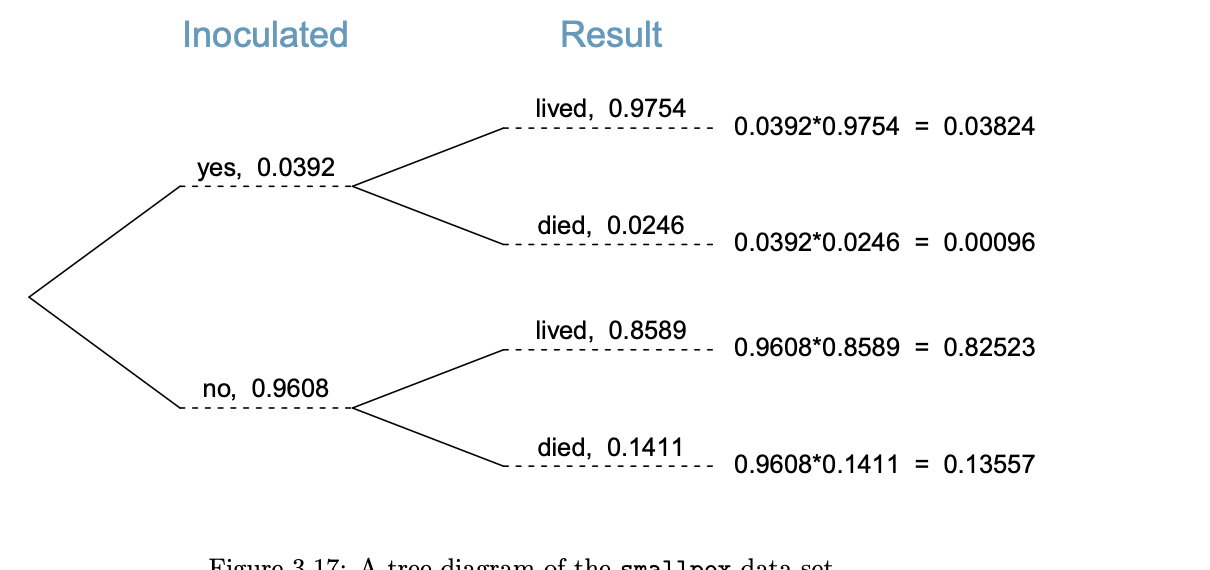
The juror’s decision tree
Tree
Three nodes: guilty and not at each, convict at the third.