HR applications are in order for the day.
A writeup
The class plan:
On Causality
Causation is at the heart of the highest order human reasoning. Doing so with data is an objective if not an end result of modern fascination with machine learning. Yet, these are age old philosophical questions and modern work at the intersection of data and causation is perhaps best exemplified in the work of Judea Pearl. His most recent work, The Book of Why, details a lifetime of investigating causes and causal models at the intersection of computing, philosophy, and statistics. Though wide ranging, his podcast with Lex Fridman is worth listening to. The excerpt on correlation and causation is very useful.
He develops a ladder of causation. This is quite well explained in this two page primer.
Associational
Interventional
Counterfactual
We want to understand precisely how these various levels influence what we learn from data and deploy data to accomplish.
The book on statistics and causal inference
Sections 2.1 to 2.10 of the Causal Mixtape are a very succinct read.
Illustrating an Hypothesis Test with the Normal
Let’s take the example of Berkeley. Let’s test the hypothesis that \(\pi=0.5\) first and let’s examine it with 99% confidence.
I will use the class tool to find that percentage.
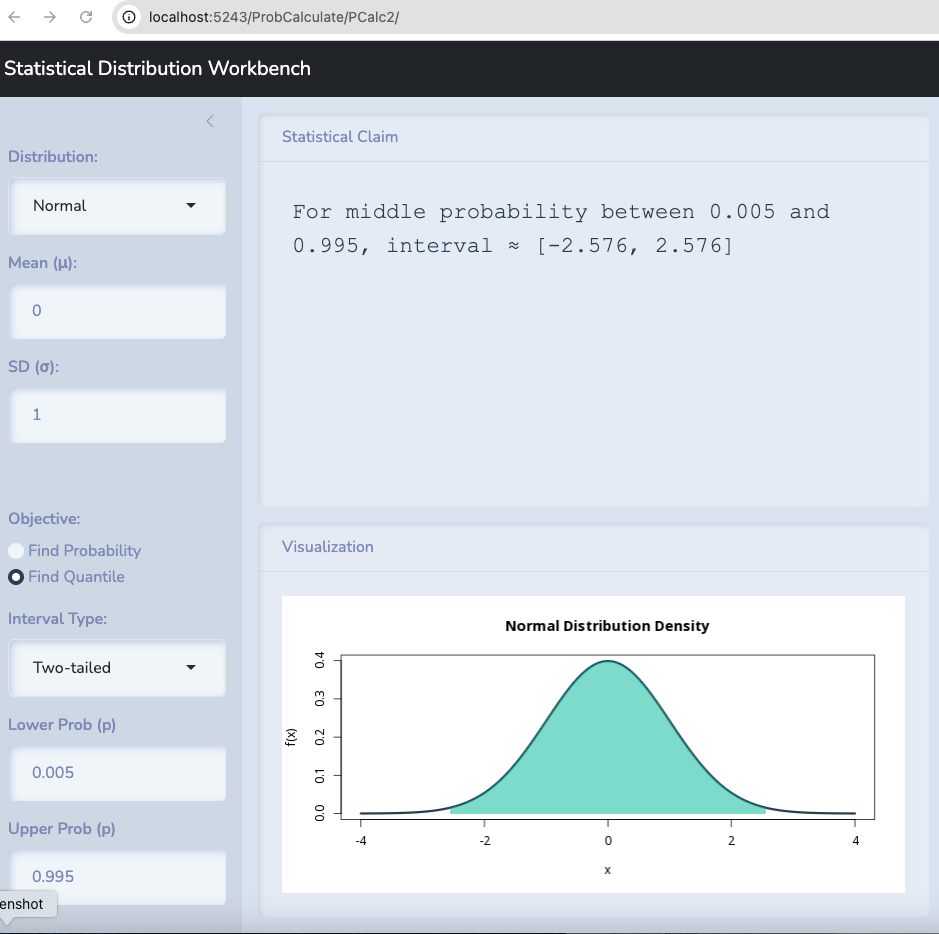
Anything within 2.576 standard deviations above or below the mean is possible with 99% confidence.
The standard error in this case is
\[\sqrt{\frac{\pi(1-\pi)}{n}}\]
This gives us \(0.5 \pm z*\) 0.0074321.
Or \(0.5 \pm 0.019\).
Anything between 0.481 and 0.519 could be observed if 0.5 is true.
A Single Tail
Let’s take the example of Berkeley. Let’s test the hypothesis that \(\pi \leq 0.5\) against the alternative that it is bigger and let’s examine it with 99% confidence.
I will use the class tool to find that percentage.
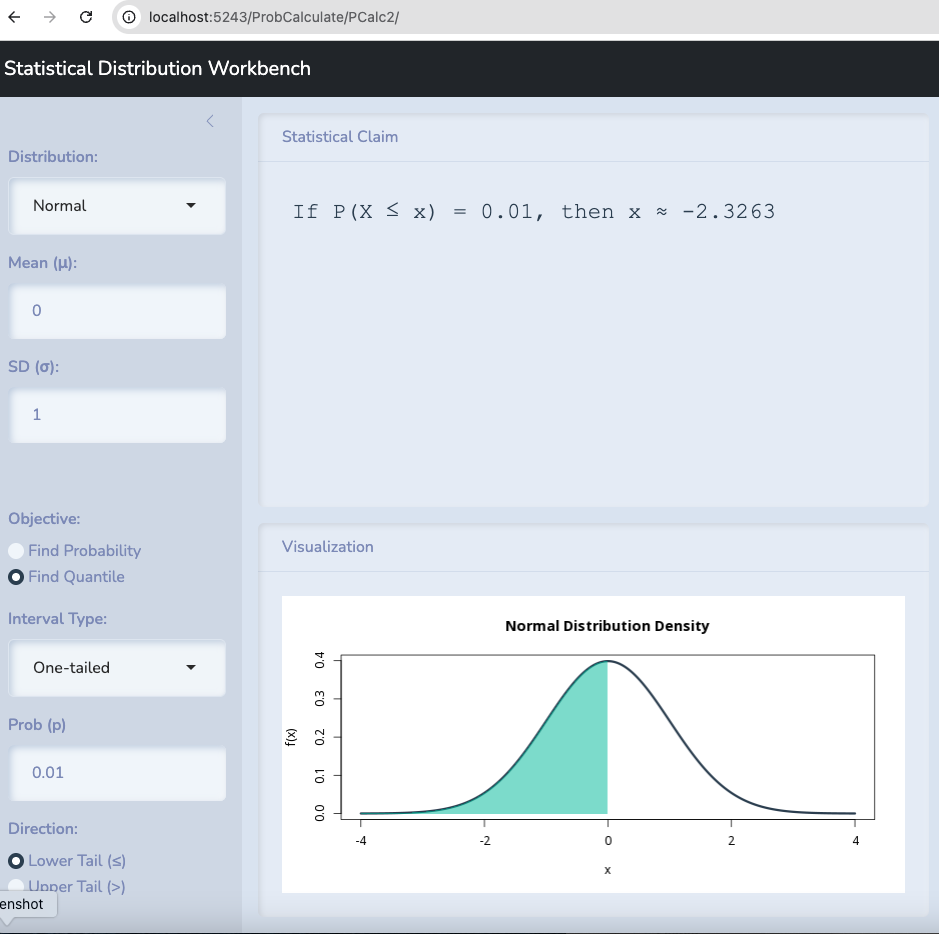
Anything within 2.236 standard deviations above the mean is possible with 99% confidence.
The standard error in this case is
\[\sqrt{\frac{\pi(1-\pi)}{n}}\]
This gives us \(0.5 - z*\) 0.0074321.
Or \(0.5 + 2.236*0.019\).
Anything below 0.5166 could be observed if 0.5 or less is true.