Today, we will spend extensive time revisiting the logic of hypothesis testing and apply it to relationships among two variables along with a backward looking exploration of existing tests.
Causation is at the heart of the highest order human reasoning. Doing so with data is an objective if not an end result of modern fascination with machine learning. Yet, these are age old philosophical questions and modern work at the intersection of data and causation is perhaps best exemplified in the work of Judea Pearl. His most recent work, The Book of Why, details a lifetime of investigating causes and causal models at the intersection of computing, philosophy, and statistics. Though wide ranging, his podcast with Lex Fridman is worth listening to. The excerpt on correlation and causation is very useful.
Let’s take the example of Berkeley. Let’s test the hypothesis that \(\pi=0.5\) first and let’s examine it with 99% confidence.
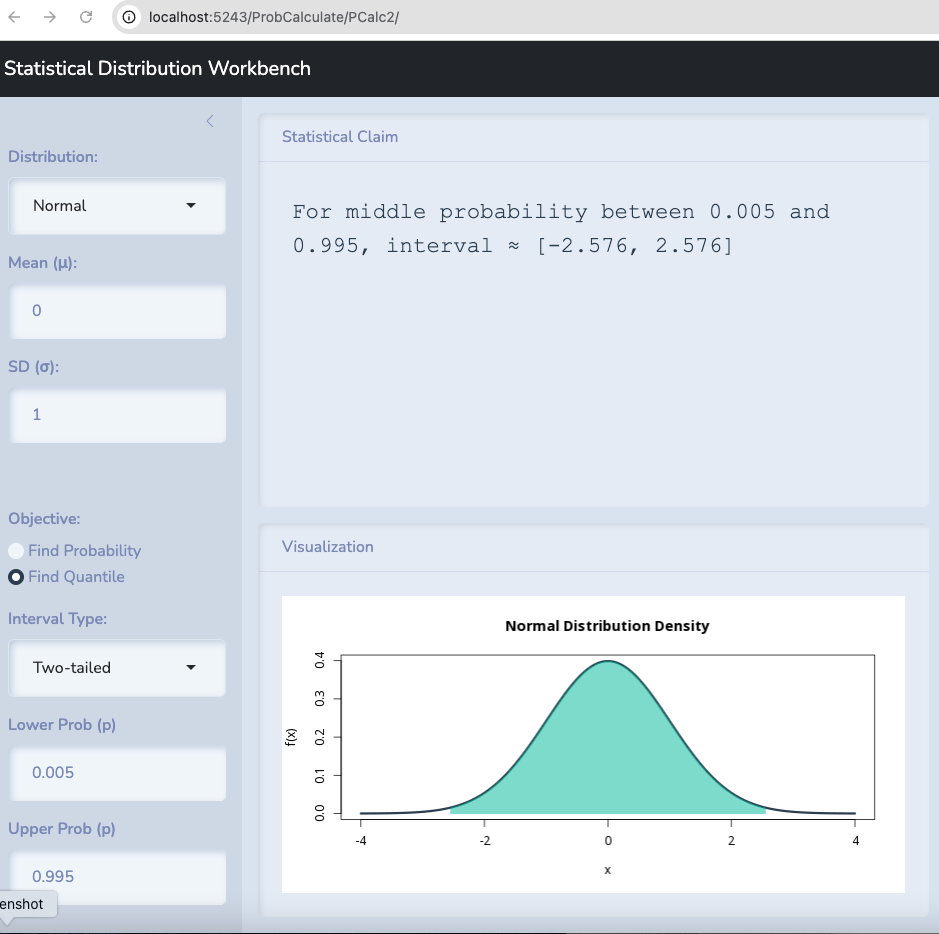
I will use the class tool to find that percentage.
Image
Anything within 2.576 standard deviations above or below the mean is possible with 99% confidence.
The standard error in this case is
\[\sqrt{\frac{\pi(1-\pi)}{n}}\]
This gives us \(0.5 \pm z*\) 0.0074321.
Or \(0.5 \pm 0.019\).
Anything between 0.481 and 0.519 could be observed if 0.5 is true.
A Single Tail
Let’s take the example of Berkeley. Let’s test the hypothesis that \(\pi \leq 0.5\) against the alternative that it is bigger and let’s examine it with 99% confidence.
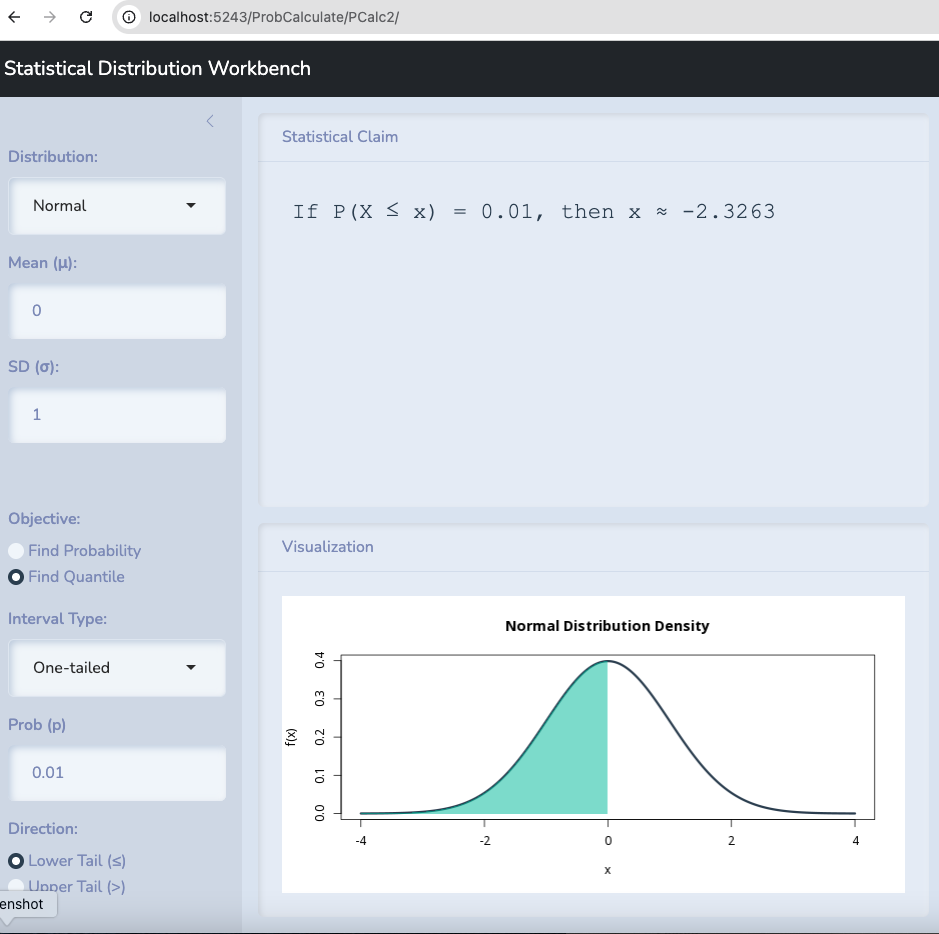
I will use the class tool to find that percentage.
Image
Anything within 2.236 standard deviations above the mean is possible with 99% confidence.
The standard error in this case is
\[\sqrt{\frac{\pi(1-\pi)}{n}}\]
This gives us \(0.5 - z*\) 0.0074321.
Or \(0.5 + 2.236*0.019\).
Anything below 0.5166 could be observed if 0.5 or less is true.
Overview
This document illustrates how ordinary least squares (OLS) regression applies to cost accounting. We simulate 52 weeks of production data, estimate a cost function, and explore the regression output interactively.
where \(\varepsilon_t \sim \mathcal{N}(16{,}750,\; 4{,}000^2)\) and \(\text{Units}_t\) follows a Poisson distribution with arrival rate \(\lambda = 2{,}000\) truncated below at \(1{,}500\).
NoteIntercept interpretation
The error term has a non-zero mean of $16,750, so the effective DGP intercept is \(16{,}750 + 16{,}750 = \$33{,}500\). The OLS estimator targets this combined value. Managers should distinguish the accounting fixed cost ($16,750) from the statistical intercept estimated by regression.
Parameters
Simulation parameters
Parameter
Symbol
Value
Poisson arrival rate
\(\lambda\)
2,000 units
Truncation lower bound
—
1,500 units
Variable cost per unit
\(\beta_1\)
$150
Fixed overhead
\(\beta_0^{\text{acct}}\)
$16,750
Error mean
\(\mu_\varepsilon\)
$16,750
Error std dev
\(\sigma_\varepsilon\)
$4,000
Effective DGP intercept
\(\beta_0^{\text{DGP}}\)
$33,500
Sample size
\(n\)
52 weeks
Interactive explorer
The widget below generates a fresh 52-week sample and provides four analytical views. Use the New sample button to resample and observe how estimates vary.
Observations
52
R²
—
Slope (β₁)
—
Intercept (β₀)
—
Show:
X-axis:
Residual mean
—
Residual std dev
—
RMSE
—
Drag slider to set production volume and read off cost forecast.
2,000
OLS prediction
—
95% PI lower
—
95% PI upper
—
Decomposition
—
Conceptual notes
Scatter plot
Each point is one week. The OLS line minimises the sum of squared vertical distances from each point to the line. Key comparisons:
OLS fit vs True DGP — in practice the true line is never observed; this toggle shows how well estimation recovers it from one year of data.
95% CI band — confidence in the mean cost at a given volume level, narrowest near \(\bar{x}\) and widening at the extremes.
Residuals diagnostic
TipWhat to look for
A well-specified model shows residuals randomly scattered around zero with constant spread. Systematic patterns suggest:
Fan shape — heteroskedasticity (variance grows with output)
Curve — non-linearity (a quadratic term may help)
Drift over time — an omitted seasonal or trend variable
Distributions
Distribution panel guide
Panel
What it shows
Units
Left boundary at 1,500 visible; Poisson shape above
Total costs
Driven by both volume variation and the error term
Residuals
Should look approximately bell-shaped, centred near zero
Prediction intervals
The 95% prediction interval (PI) is wider than a confidence interval (CI) because it covers a single future week, not the mean:
Resample repeatedly to observe how much \(\hat{\beta}_0\), \(\hat{\beta}_1\), and \(R^2\) fluctuate. Regression coefficients are themselves random variables.