flowchart TB
    A["Input representations"] --> B1["Head 1"]
    A --> B2["Head 2"]
    A --> B3["Head 3"]
    A --> B4["Head 4"]
    B1 --> C["Concatenate"]
    B2 --> C
    B3 --> C
    B4 --> C
    C --> D["Project to new representation"]
Intelligence, AI, and LLM’s
Outline
- The Basics of LLM’s.
- Embeddings.
- Attention is all you need.
- Embeddings.
- The Prediction.
- The Context.
- The Parameters.
- The Context.
Roadmap
- What language models do
- Tokens and embeddings
- Context and attention
- Transformer architecture
- Training and alignment
- Strengths, limits, and interpretation
What is a language model?
A language model estimates the probability of the next token from earlier tokens:
\[ P(t_k \mid t_1, t_2, \ldots, t_{k-1}) \]
Attention as weighted influence
\[ \text{Attention}(Q,K,V)=\text{softmax}\left(\frac{QK^T}{\sqrt{d_k}}\right)V \]
You do not need every algebraic detail to get the idea:
- compare token features
- compute relevance weights
- blend information from multiple positions
The result is a new representation that depends on context.
Multi-head attention
Different heads can learn different relational patterns, though their roles are not always cleanly interpretable.
Fine-tuning, instruction tuning, and alignment
flowchart LR
    A["Pretrained base model"] --> B["Supervised fine-tuning"]
    B --> C["Preference / feedback tuning"]
    C --> D["Aligned assistant behavior"]
Post-training aims to make the system:
- follow instructions
- be more useful in conversation
- reduce unsafe or low-quality outputs
- better match human preferences
What “understanding” means here
Strong appearance of understanding - explanation - summarization - translation - coding help - question answering
Reasons for caution - no guaranteed grounding - confidence ≠ truth - behavior can be brittle - “understanding” remains debated
A compact mental model
flowchart LR
    A["Text"] --> B["Tokens"]
    B --> C["Embeddings"]
    C --> D["Attention + transformer layers"]
    D --> E["Predicted next token"]
    E --> F["Repeat"]
    D --> G["Post-training / alignment"]
    G --> H["Assistant behavior"]
Summary
- Tokenization breaks text into manageable units.
- Embeddings map those units into vector space.
- Attention lets tokens influence one another contextually.
- Transformers scale this idea very effectively.
- Training + post-training turn a predictor into a usable assistant.
- Limits remain fundamental, not incidental.
The Prompt
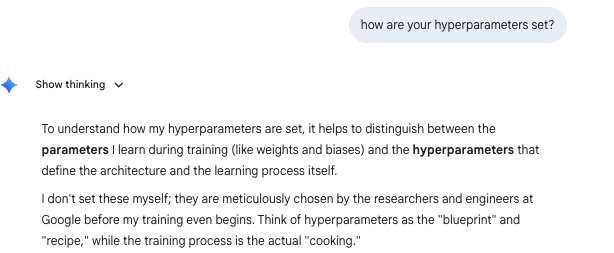
Architectural Hyperparameters
The Structural “Skeleton”
Before training, engineers define the model’s capacity and complexity. These values are fixed once training starts.
- Number of Layers: The depth of the transformer model.
- Hidden Dimension Size: The width of the vector representations.
- Attention Heads: The number of simultaneous “perspectives” used to process context.
- Vocabulary Size: Total unique tokens (parts of words) the model can recognize.
Training Hyperparameters
The “Learning Recipe”
These settings control the optimization process as the model learns from massive datasets.
- Learning Rate: Controls the “step size” for weight updates. Too high leads to instability; too low leads to glacial progress.
- Batch Size: Number of examples processed before internal weights are updated.
- Optimizer Settings: Algorithms like Adam or Adafactor use specific constants (e.g., \(\beta_1, \beta_2\)) to manage momentum during learning.
Finding the “Sweet Spot”
Selection Strategies
Researchers use various methods to find the most efficient hyperparameter combinations.
| Method | Description |
|---|---|
| Grid Search | Testing every possible combination (exhaustive but slow). |
| Random Search | Randomly sampling combinations; surprisingly efficient. |
| Bayesian Optimization | Mathematical modeling to predict optimal settings based on past trials. |
| Scaling Laws | Using formulas (like Chinchilla) to predict performance before scaling up. |
Inference-Time Hyperparameters
The “Personality” Settings
These values are adjustable after training to control how the model generates responses.
- Temperature: Controls randomness. Low = precise/safe; High = creative/unpredictable.
- Top-P (Nucleus Sampling): Limits word choice to the most likely tokens whose cumulative probability exceeds \(P\).
- Presence/Frequency Penalties: Mathematical “nudges” that prevent the model from repeating the same words or phrases too often.
The Core Concept of Temperature
Temperature (\(\theta\)) is a hyperparameter used to control the randomness and confidence of a language model’s output.
- The Dial: Think of it as a “creativity” slider.
- Low Temperature: Makes the model more “confident” and deterministic, favoring the most likely tokens.
- High Temperature: Makes the model more “creative” or “excited,” allowing lower-probability tokens a higher chance of being selected.
The Mathematical Engine
Temperature modifies the standard Softmax function applied to the model’s raw output scores (logits).
- Logits (\(z\)): The raw, unnormalized scores for each possible next word.
- The Modified Softmax: We divide each logit by the temperature \(\theta\) before normalizing:
\[\sigma(z_i) = \frac{e^{z_i/\theta}}{\sum_{j=0}^{N} e^{z_j/\theta}}\]
- Scaling Effect: * If \(\theta \to 0\), the distribution becomes “pointy” (argmax).
- If \(\theta \to \infty\), the distribution becomes uniform (pure noise).
Practical Applications
Choosing the right temperature depends entirely on the specific task:
| Task Type | Temp Setting | Benefit |
|---|---|---|
| Fact-based Q&A | Low (\(< 0.3\)) | Increases accuracy and reduces hallucinations. |
| Code Generation | Low (\(0.0 - 0.2\)) | Ensures syntactic correctness and stability. |
| Creative Writing | High (\(0.7 - 1.2\)) | Produces diverse, varied, and interesting prose. |
| Brainstorming | High (\(> 1.0\)) | Explores unconventional or “edge-case” ideas. |
Key Components
From an LLM architecture perspective:
- Logit Scaling: In Transformer-based models, temperature is purely a post-processing step during the inference phase. It does not change the model’s weights, only how we interpret the output probabilities.
- Information Theory: Mathematically, increasing temperature increases the entropy of the probability distribution. This aligns with the “creativity” intuition—higher entropy means less predictability.
- The “Greedy” Limit: As \(\theta\) approaches 0, the model performs “Greedy Search,” where it picks the single highest probability token every single time, which is why low temperature is best for technical tasks.
Discussion Question
For many things, isn’t temperature 0 ideal?
* When?
* When not?
I asked Gemini
In your own case, what is the model depth, width, how many attention heads, and what vocabulary size?The Core Engine: Sparse MoE
The “Flash” Efficiency Factor
Instead of a single “dense” block, I use a Sparse Mixture-of-Experts (MoE) architecture.
- Expert Sub-networks: My internal structure consists of multiple specialized sub-networks.
- Active Parameters: For every word I process, only a specific subset of “experts” is activated.
- Result: This allows me to maintain high reasoning capability while responding with the speed expected of a “Flash” model.
Vocabulary & Multimodality
Breadth of Understanding
My vocabulary isn’t just a list of words; it’s a bridge between different types of data.
- Vocabulary Size: 256,000 unique tokens (SentencePiece unigram).
- Multimodal Native: I process text, image, audio, video, and code within the same architectural framework.
- Efficiency: A larger vocabulary allows for more efficient processing of diverse languages and technical code.
Architectural Summary
Summary of Gemini 3 Flash Specs
| Hyperparameter | Specification |
|---|---|
| Model Type | Sparse Mixture-of-Experts (MoE) |
| Vocabulary Size | 256,000 tokens |
| Context Window | Up to 1,000,000 tokens |
| Distillation | Optimized from larger Gemini 3 variants |
Key Takeaway: My performance is the result of distillation, where I am trained to mimic the logic of larger models while maintaining a lean “active” parameter count.